Before future posts start branching off into individual concepts and features, below is a quick overview of the prototype’s core concepts to serve as a point of reference.
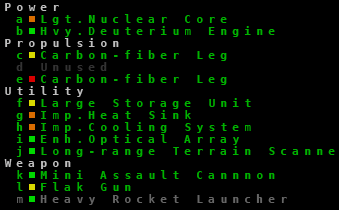
As the “Cogmind,” you play a special robot that can attach to any kind of part, all of which fall into one of four categories:
- Power Sources: Engines, power cores, and reactors supply the power necessary to run other systems.
- Propulsion: Treads, legs, wheels, and hover/flight units enable a robot to move more quickly (multiple types can be attached, though only a single category can be active at a time).
- Utilities: Special devices, processors, storage units, and protective gear that provide a wide range of benefits.
- Weapons: Guns, cannons, and launchers.
The number of each type of part that can be attached at once is limited to your number of slots for that type. Cogmind starts out with a small number of slots, and as you advance through the world Cogmind adds new slot types of your choosing by “evolving” (as mentioned, you’re not a normal robot--in the new Cogmind, you’re not even a robot at all, but exactly what you are isn’t revealed until later in the game).
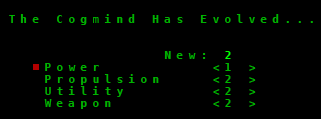
The evolution screen needs a… little fixing up.
Individual parts can be destroyed or removed without any negative impact on Cogmind; it’s the “core” that matters. The core is what all the parts attach to, and if it’s destroyed (or 100% corrupted), then Cogmind is no more. All robots in the game are built using the same system, so defeating enemies by destroying/corrupting their core means Cogmind can then cannibalize them for any remaining intact parts.
Aside from parts, there are two primary resources:
- Energy: Generated by the core and power sources; necessary for moving, firing energy-based weapons, and sustaining the operation of some utility systems.
- Matter: Salvaged from robot remains; used to fuse components, and consumed by ballistic weapons and launchers as ammunition.
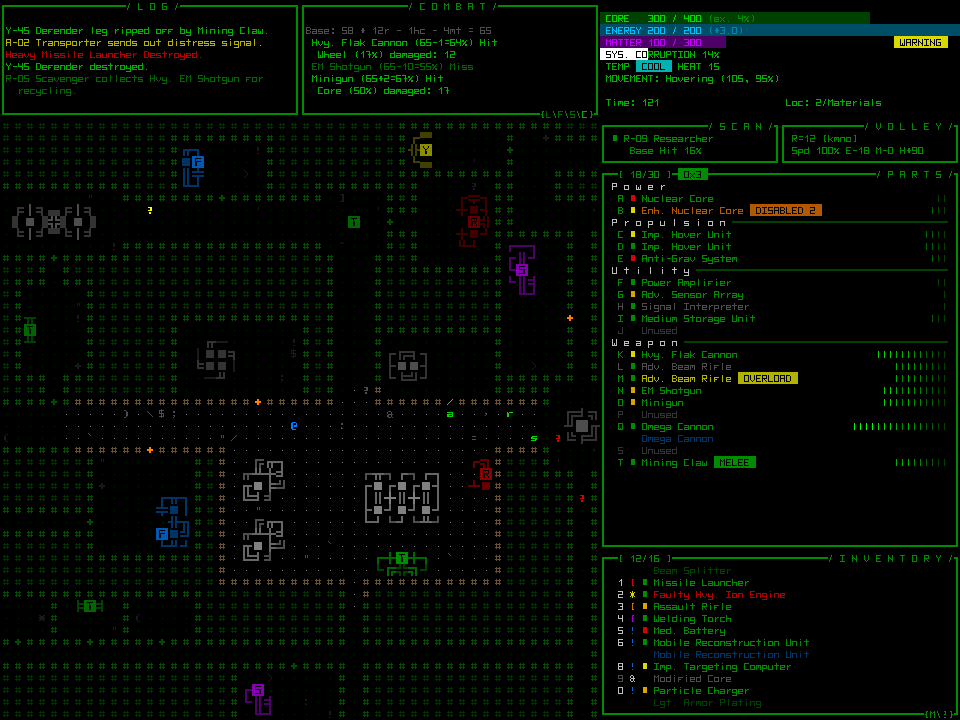
Attacking is handled via the “volley” system: All weapons set to “active” will be fired at the target when you attack. You won’t always want to fire everything at your disposal though, since it will take longer, drain more resources, generate more heat, and some weapons may be less appropriate for a given target type or situation.

Volley statistics are updated in real time while browsing through targets or activating/deactivating weapons to display range, resource costs, etc.
That’s a basic summary of the core gameplay, which will remain unchanged. Soon we’ll be covering individual features in more detail, many in the context of how they are being improved or expanded, and why.
A more detailed description of the 7DRL game rules can be read in the game manual, available online here, and an even more detailed description of game mechanics is included in the 7DRL download as “manual2.txt”.
 RSS (posts)
 Mastodon
 Patreon
 Discord
 /r/Cogmind
 Indie DB